Purposeful intervention: the theories that guide psycho pedagogical advising
DOI:
https://doi.org/10.32093/ambits.vi.63.504990Keywords:
Psycho-pedagogical advising,, Explicit theories, Implicit theories, Dialogical accompaniment, Generative AI in counsellingAbstract
The article starts from the phrase attributed to Kurt Lewin —there is nothing more practical than a good theory— to argue that any rigorous psycho pedagogical intervention needs a solid theoretical foundation. The author recalls that the absence of theory entails risks: arbitrariness, difficulty in justifying decisions, maintenance of prejudices and loss of coherence between professionals. However, even in complex practices such as counselling, one always intervenes “with meaning”; the problem is not the “what for”, but the “why” one acts in one way and not another.
The text distinguishes three main sources of knowledge for counsellors:
1) Explicit or scientific theories, coming from consolidated models and based on research. The article presents and compares four currently dominant approaches in counselling —clinical-assistance, educational-collaborative, socio-community and dialogic.
2) Implicit theories or beliefs, derived from everyday experience, often resistant to change and with frequent biases, although they can be functional in urgent situations.
3) Informed or dialogued theories, the result of interaction with mentors, colleagues, and digital resources, more recently, with Generative Artificial Intelligence (GEMAI), understood as an emerging dialogical actor.
The article concludes by emphasizing that theory and practice are inseparable: all practice expresses a theory, explicit or not. Therefore, bad practice always derives from bad theory. The professional task consists of bringing both dimensions into dialogue to improve the quality of advice.
References
Ainscow, M. (2024). Developing Inclusive Schools: Pathways to Success. New York: Rutledge.
Andrades-Moya, J., & Pérez Álvarez, E. (2024). Approaches to the Concept of Educational Community, From the Perspective of School Coexistence: A Participatory Dialogic Study. Educational Researchfor Social Change, 13(2), 1-24.https://doi.org/10.5281/zenodo.14031245
Akiba, D. I Fraboni, MC (2023). AI-Supported Academic Advising: Exploring Chat GPT’s Current State and Future Potential toward Student Empowerment. Education Sciences, 13(9).https://doi.org/10.3390/ educsci13090885
Domingo, J. (2001). Asesoramiento al centro educativo: colaboración y cambio institucional. Barcelona: Octaedro.
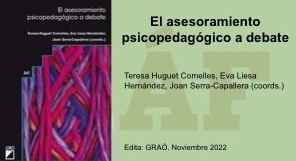
Huguet, T., Liesa, E. i Serra-Capallera, J. (2022). El asesoramiento psicopedagógico a debate. Barcelona: Graó.
Jiménez, J. E. (2022). Neuropsicología y dificultades del aprendizaje. Madrid: Pirámide.
Kitching, E., Mullen, P. R., Chae, N., &Backer, A. (2024). School Counsellors’ Experiences of Induction and Mentoring. Professional School Counseling, 28(1). https://doi.org/10.1177/2156759X241290492
Lago, J.R. i Onrubia, J. (2011). Asesoramiento psicopedagógico para la mejora de la práctica educativa. Barcelona: Horsori.
Luna, M. i Martín, E. (2008). La importancia de las concepciones en el asesoramiento psicopedagógico. Profesorado: revista de curriculum y formación del profesorado, 12(1); 1-12.
Lyon, G. R. (2020). Science, psychology, and education: A continuing dialogue. New York: Guilford Press.
Majjate, H; Bellarhmouch, Y; Jeghal, A., Yahyaouy, A. Tairi, H. &Zidani, KA. (2024).AI-Powered Academic Guidance and Counseling System Basedon Student Profile and Interests. Applied System Innovation, 7(1). https://doi.org/10.3390/asi7010006
Martín, E., Pozo, J.I., Cervi, J., Pecharromán, A., Mateos, M, Pérez Echevarría, M del P., i Martínez, P. (2005). ¿Mantienen los psicopedagogos las mismas concepciones que el profesorado, acerca de la enseñanza y el aprendizaje? (pp. 69-88). En C. Monereo i J.I. Pozo (edit.). La práctica del asesoramiento educativo a examen. Barcelona: Graó.
Martínez Muñoz, M., Martínez-Pons, M. & Sánchez-Martí, A. (2024). Centros de referencia en orientación educativa en Cataluña. Revista Española de Orientación y Psicopedagogía (REOP), 35(3), 179-196. https://doi.org/10.5944/reop.vol.35.num.3.2024.40939
Monereo, C. (2022). La formación de la identidad asesora: crear contextos de intervención a través del diálogo asesor (pp. 96-114). En Huguet, T., Liesa, E. i Serra-Capallera, J. El asesoramiento psicopedagógico a debate. Barcelona: Graó.
Monereo, C., Badia, A. i Liesa, E. (2024). Guía para la orientación educativa a partir de un modelo de acompañamiento (GOMA). Madrid: Organización de Estados Iberoamericanos para la Educación, la Ciencia y la Cultura (OEI).
Monereo, C. I Hermans, H. (2023). Education and dialogical self: state of art. Journal for the Study of Education and Development, 46(3). https://doi.org/10.1080/02103702.2023.2201562
Monereo, C. i Solé, I. (Coord.) (1996). El asesoramiento psicopedagógico: una perspectiva profesional y constructivista. Madrid: Alianza Editorial.
Monereo, C., Suñé-Soler, N. i Fecho, B. (2022) The Identity of the acadèmic advisor: Towards a new framework of Dialogical Advice. A C. Monereo. The Identity of Education Professionals. Positioning, training&innovation. Charlotte, USA: Information Age Publishing (IAP).
Mytsenko, V. i Stezhko, Y. (2025). A Coaching approach to the formation of meta-skills “Cooperation” with Artificial Intelligence. Education Innovation Practice 13(5):19-26. https://doi.org/10.31110/2616-650Xvol13i5- 003
Phan, T.Y. i Dang, V. (2025). Impact of Information Technology in Educational Counselling for High School Students. International Journal of Education Teaching and Social Sciences, 5(2):1-9. https://doi.org/10.47747/ijets.v5i2.2628
Pozo, J.I. (coord.) (2006). Nuevas formas de pensar la enseñanza y el aprendizaje. Las concepciones de profesores y alumnos. Barcelona: Graó.
Sánchez-Miguel. E. (2000) Profesores y psicopedagogos: un estudio observacional sobre las dificultades de los psicopedagogos para trabajar con los profesores. Infancia y Aprendizaje, 23(91). https://doi. org/10.1174/021037000760087865
Thottoli, MM., Alruqaishi, BH i Soosaimanickam, A. (2024). Rob academic advisor: Can chat bots and artificial intelligence replace human interaction? Contemporary Educational Technology, 16(1). https://doi.org/10.30935/cedtech/13948
Wegerif, R. (2024). Oracle or Dialogue Partner? Towards a polyphonic, situated AI. Wilder Journal, 2(1). https://journal.platoniq.net/en/wilder-journal-2/deep-dives/ai-dialogue/
Downloads
Published
Issue
Section
License
Copyright (c) 2026 Carles Monereo

This work is licensed under a Creative Commons Attribution-NonCommercial-NoDerivatives 4.0 International License.
The authors maintain their copyright and give the right to the first publication of the work to the journal, registered under a Creative Commons Attribution-Non Commercial-NoDerivs license. This license allows others to download the works and to share them with others as long as they credit the author, but it does not allow for any kind of modification or commercial use.